Saturday, February 22, 2025

Reflections: The Sacred Veil

For those of you who are not aware, I have performed with Canterbury Voices since January of 2015; this year marks my 11th season singing with Canterbury, including two years in Canterbury Chamber Voices (smaller ensemble). Canterbury is the largest symphonic choir within Oklahoma and routinely performs at Oklahoma City's Civic Center Music Hall with the Oklahoma City Philharmonic Orchestra.

On Saturday, March 1, 2025, Canterbury Voices will perform The Sacred Veil as created by composer Eric Whitaker and lyricist Charles Anthony "Tony" Silvestri. The Scared Veil weaves the story of Tony’s wife, Julie, and her battle with ovarian cancer into a reflection on the subtle divide (the "veil") between our present lives and eternity. The text comes from Tony’s reflective poetry and Julie’s own words from a blog she kept during her experiences. This concert features Jonathan Ruck, cello, and David Hillis, piano.


Although we have been rehearsing The Sacred Veil since January, it was not until a couple of weeks ago that I took the opportunity to simply listen to a recording of the full work (by the Los Angeles Master Chorale) in order movement-by-movement. The text is certainly soul gripping due to the nature of the story, especially in movement six, "I'm Afraid", where we hear the detailed medical jargon used for Julie’s diagnoses and treatment plans (several years of this path merged into one musical movement) and in movement eleven, "You Rise, I Fall", when Julie takes her final breath. In the midst of this soul gripping journey, there are moments of deep love, laughter, romance, and "delicious" times. 

While listening to The Sacred Veil, I reflected on many important people in my own life who have battled cancer, some surviving and some who did not - whether family, friends, and colleagues their lives, love, and legacies are a significant part of who I am and they will be at the forefront of my thoughts during the March 1st concert.

— In memory of Aunt Leona J., Aunt Nancy, Jamie, Debbie, Mike, Earl, Kevin and others.

— In honor of Shelley, Troy, Becky, Ron, Beth, Chelsee, Liz, Roy, Brook, Emily, Crystal, and others.

I’ll also be thinking of several colleagues, friends, and family members who are in the midst of a cancer battle right now.

— In prayer for Krystal, Stephanie, Shawn, Rick, Abby, and others.

While the story behind The Sacred Veil is about lives impacted by cancer, the story also carries similar themes with other aspects of loss that are part of our human experience. Whether the loss comes more slowly through a lengthy battle with some other illness or through a more sudden flashing and unexpected moment, loss and grief eventually impact all of us. During loss and grief, we all grapple with a variety of emotions and reflections, including those related to what happens after death - what is going on with our loved ones on the other side of that "sacred veil".

Additionally, it is not lost on me that many who will be on the stage or in the audience will also be reflecting on lives lost and otherwise impacted by the April 19, 1995 bombing of the Murrah Federal Building in Oklahoma City; this concert will be presented roughly 1-1/2 months before the 30th anniversary of the bombing. 

And so, while singing I’ll also be reflecting on those who have survived, those who are fighting this terrible disease, and those already on the other side of "the sacred veil".


Sunday, April 8, 2018

Consolidate This

Over the past few weeks, especially in the aftermath of the threat of a state-wide teacher walkout in Oklahoma...and then the actual walkout which continues into day 6 tomorrow, I've heard and read lots of thoughts regarding consolidation. With all of this discussion I had been brainstorming a blog post on the topic, but I've been busy supporting my district's teachers in the walkout (both by being at the Capitol People's House in person and helping to give the ACT to our district's juniors).

This evening I received a message from a good friend asking for my thoughts on how to respond to a meme making the social media rounds comparing Oklahoma and Florida in relation to the idea of consolidation. I wrote back mentioning that I've been planning to write a post about it and promised to do it tonight. Over dinner, I was scrolling through Facebook and multiple friends were sharing a post about consolidation that was attributed to one of our state senators, but not shared from him directly. I liked the content of the post, but felt the need to confirm the authenticity before sharing it myself. I've since sent the senator a private FB message and he replied confirming that he wrote it.

So, I'd like to begin with these comments being shared around Facebook today that are confirmed to be from Senator Rob Sharp, a Republican serving Senate District 17 (eastern Oklahoma County and northern Pottawatomie County).

One of the many myths in Oklahoma is consolidation of school districts will save taxpayer money. In truth, it is quite the opposite!
The base of funding Oklahoma's education system is local dollars (known as dedicated revenue). Subsequently, there are 37 school districts that receive ZERO State appropriated dollars because of the wealth of that school district in which the students attend.
There are another 64 school districts that receive ZERO foundation aide from the State because of the of its wealth.
The remaining school districts receive State appropriated dollars on the basis of equity. Of these school districts on the average about 52% of the school district's money comes from local dedicated funds and the remainder from State appropriated funds.
The State only supplements what the local wealth does not provide. And, this is done on a per pupil appropriation (Average Daily Membership) , and NOT DONE ON THE NUMBER OF SCHOOL DISTRICTS!
Therefore, the NUMBER of School Districts in Oklahoma is irrelevant to the State's appropriated dollars.
There are currently 696, 486 students in Oklahoma's public schools. If there were only 2 school districts in Oklahoma, or 515 school districts it would still cost the State of Oklahoma the same amount of dollars.
Those school districts that are losing students (ADM) are forced to close their doors by voluntary consolidation. Neither local or appropriated dollars can save that district because both local and State appropriated dollars is based on ADM.
Several problems are created with forced consolidation:
1) the debt of the closed district will follow to the new district (changes would be required to raise the capped debt of a school district)
2) the closed district probably has a very low ad valorem assessment and only posses a financial burden to the new district
3) BIG PROBLEM- any attempt to force consolidation would require ad valorem to be under the State legislature control. Otherwise, the State would be bankrupt without the local dollars that forms the base of school district funding.
4) Currently, the State does not receive any of the ad valorem dollars. All ad valorem remains within the county for distribution. 
5) All buildings within a school district are approved by local taxpayer bond issues. The State has ZERO investment in local school buildings. Bond issues require a 60% taxpayer approval. And, then maintained by 35 mill levies approved by the local district taxpayers. All of this would be required to change under any attempt at forced consolidation. All local ad valorem would be required to be placed into one State-wide revolving fund for distribution. (SOCIALISM).
6) Oklahoma's education funding formula is considered the best in the US. 
7) It is not the education funding formula that is the problem, it is the insufficient amount of revenue the State is providing as its share of the formula.

Again, those are Senator Sharp's thoughts. I happen to find them brilliant.

Following my private messaging with Senator Sharp, he personally went to the original post where I had found the words attributed to him (the words he confirmed as his) and posted an additional statement which I feel adds greater clarity to his original comments:
There have been two studies on school consolidation that have significant credibility:
1) Vernon Florence's "Study on School Consolidation". Mr. Florence is probably the most knowledgeable authority on the Oklahoma education funding formula. His research concluded that not only does school district consolidation not save the State any money, but would actually increase costs. [Mr. Florence teaches education finance to superintendents at CCOSA]
2) The Education Commission of the States presented a study to the Oklahoma Education Formula Task Force on December 20, 2017. The fiscal analysts, Emily Parker and Michael Griffith, related that States that have consolidated have not experienced any savings and have actually increased costs. The analysis from their study confirmed the Oklahoma Education Funding formula was the best in the US, and that other States would benefit from using this formula. Parker and Griffith related on December 20, 2017, it was the larger school districts with a student population of 25 thousand plus that created the bloat of administrative and per pupil costs. The conclusion from this study was the smaller school districts were actually the most cost efficient, student scores the best, and student appreciation for their social environment the most satisfactory.
There have been those who have countered, "Why not consolidate just the superintendents and not the actual districts themselves? Have one county-wide superintendent serving multiple school districts?"

Well, if each school district remains independent and, thus, still has its own locally elected school board you would end up with an interesting situation: one individual serving multiple sets of bosses. Each board would have to approve the hiring of the individual to serve as the collective superintendent. Each independent district would be paying a percentage of this superintendent's salary. The likelihood of unanimity of vision among all of the districts/school boards is not likely. So how does this superintendent figure out how to act when differing districts/school boards give him conflicting orders or objectives to follow? How does the superintendent appropriately divide his/her time up in serving each district? An individual can only be in one place at one time. Matthew 6:24 gives some insight here: "No one can serve two masters; for either he will hate the one and love the other, or he will be devoted to one and despise the other...". Granted, this scripture was alluding to a different topic, but it's still applicable here. A single superintendent with multiple, potentially conflicting/competing bosses, has virtually no ability to help oversee a quality education for all of the students being served.

If two or more local communities happen to decide on their own that consolidation makes the most sense for the educational needs of their students, then let them make that decision. There should not be any effort to impose such a forced consolidation upon any district by the government of the state of Oklahoma. In most cases it neither makes sense or cents.

Monday, April 2, 2018

Oklahoma Teacher Walkout: Day One

Today has been an emotional day. Approximately 30,000 teachers, administrators, vital support staff, parents, students, and other supports (including many state employees) descended upon the Oklahoma State Capitol today to advocate for the needs of increased funding to support the educational needs of the 680,000+ students in Oklahoma's public schools.

I attempted to visit with nearly all of the Representatives and Senators who serve an electoral district that includes a piece of Moore Public Schools. Of those I visited in person, some were honest and legitimate supporters of public education even if we happen to disagree with the mechanics of how to accomplish the goals of fully funding the needs of our students. One gave a D- attempt at a song and dance around the issues--imagine that uber slick car salesman at that slick auto dealership in your town and then imagine the schmuck that doesn't have the finesse to land a job at the slick dealership and works at the dumpy lot in the "bad" neighborhood and he is trying to convince you that the 25 year old jalopy is the most advanced and equipped car ever created--that was the nature of this song and dance; I almost felt sorry for him for that poor performance. And then there were the ones who wouldn't even make time available to visit with their constituents...it's easy to guess where they stand.

But I don't want to spend too much time talking about the lawmakers, and the anger I hold for some of them. I want to focus on the aspects of today that brought me joy, and, at times, joyful tears.

I spent the whole day with Jennifer, Julie, and Shelia, three of our wonderful elementary teachers. At times throughout the day we were joined for some of our legislator visits by other amazing teacher friends. Each of these teachers shared their stories of trying to teach 30 or more first graders or kindergartners in one room. Folks, that's a whole lot of little people to tie shoes, wipe noses, keep in line or in their seat or on the story carpet, etc., all the while trying to present whole group and small group lessons to help develop their little minds. My first year I had a class of 36 sophomores crammed into a portable classroom for geometry and I would gladly take those 36 kids over even five squirmy kindergartners--yet these ladies make it look so easy. They told the stories behind why classes are so large... a new quality first grade teacher applicant could not be found despite the best efforts of the school and district. The teacher shortage is real. The struggle is real. And yet these ladies are consummate professionals who refuse to let their kids know that they are being shortchanged. With heads held high and love in their hearts for their kids, they walk into those classrooms determined to give it their all because those precious kids are worth it.

Throughout the day as I had cellular connectivity (even on a normal day at the Capitol cell service is spotty inside those thick granite walls, but more so with 30,000 people trying to use their phones), my heart would be stirred by seeing a text or social media post from teacher friends across this country letting me know that they were with us in spirit despite being in Iowa or Colorado or New York or Georgia or California. These are teachers who I've met as part of the professional development programs that have taken all across the United States and to numerous intentional destinations. You would never believe that some of the teachers I've met on those programs have become some of my dearest friends. And I love the fact that one of them has two kids who are wicked fans of the OKC Thunder and I've traveled to Sacramento to join them for a game. The simple words of love and support that they have shared today or over the past week have meant more in this struggle than they could ever know.

Only a small fraction of the 30,000 people actually came inside the Capitol building. Most rallied outside. Many shared pictures of the many protest signs being carried and pictures of dear friends and co-educators from my district marching in solidarity. Some took time to write out their teacher story of educational funding complications on social media. Catching glimpses of those postings during strong connectivity times as well as once I got home have been extra encouraging to the entire cause. Three special stories really grabbed my attention.

Story#1: One of my principal buddies, Seth Meier from Oakridge Elementary, shared one of the stories on Facebook:
And for more of the details of the story, the mother herself posted about the experience <click here>

Story #2: A group of band teachers from around the state organized themselves to bring their personal instruments and play some tunes to energize the crowds outside. One of the songs that is trending across social media was their rendition of Twisted Sister's "We're Not Gonna Take It". This video was captured by Jordan Nguyen, the wife of my friend Philip who teaches music at Bryant Elementary.

Story #3: I have a handful of friends who teach at Edmond Memorial High School in a neighboring district. One of their teachers carried out the idea of some of his students and brought their classroom to the Capitol lawn. This morning Regan Killackey and his students had AP English together so they could continue preparing for the rapidly approaching AP exams. This is one of the stories being highlighted within national media, such as this story and video in Newsweek. <click here>

Today's walkout and school closing is the first of what could be many, many days. Most participants are willing to stay out of the classroom until the legislature significantly funds or creates a clear pathway to fund Oklahoma's schools. I don't know when this will occur; I hope sooner than later. The one thing that I do know is that, at least right now, our communities support our teachers because they understand the teachers did not walkout on our students--they've walked out FOR our students.

Sunday, March 25, 2018

Students' Voices

From the start, this post is not intended to address (either pro or con) the motivations nor the substance behind the recent student led "March for Our Lives". This post is NOT about defending any perspective on gun rights, gun control, the Second Amendment, etc. You'll need to go elsewhere to find and discuss those topics.

This post is about students and the rightful place for the expression of their voice. As a passionate Social Studies educator (history, geography, political science, economics, psychology, sociology, etc.), one of my primary goals is for students to think about, explore, discuss/debate, and compare the sundry aspects of human interaction across time and space. Further, I want my students to take those lessons and apply them to their personal lives and the collective lives of society for the purpose of making the world a better place. Do I proscribe for them a specific path or set of ideas that will create the perfect world? NO! The "whys" are for them to decide as are the "hows" they choose to use.

In December of 1965, Mary Beth Tinker, her brother John, and a small group of their friends chose to shift their ideas regarding the Vietnam War from conversation to action. They all wore black arm bands to their schools in Des Moines, Iowa, as a protest against the war. (Again, this post is neither pro or con regarding the merits of the arm band protest nor the war in Vietnam.) The students were coerced into removing their arm bands in the face of disciplinary action from the school district. The students' families believed that their students' First Amendment rights were being unnecessarily violated. Following years of decisions and appeals, the Tinker v. Des Moines case landed before the U.S. Supreme Court. In their landmark 1969 decision, the Court ruled 7 to 2 that the students' rights were indeed violated.

The Court did not rule that any/all protests by students at school were automatically protected by the First Amendment. The Court, reasonably, recognized that there would plausibly be protests which could unnecessarily disrupt the educational mission of a school and/or hinder other students from their rights in obtaining an education. While there are limits surrounding students protesting in the educational setting, those peaceful protests which do not overtly disrupt the educational process are protected.

For more information on the Tinker case, click here OR click here.

Questions surrounding student led protests within the educational context have come back to the forefront in the aftermath of the shooting which occurred at Stoneman Douglas High School in Parkland, Florida, on February 14, 2018. In the shooting, 17 students and staff members from the high school lost their lives. Within the immediate aftermath of the shooting, some students from Stoneman Douglas gained notoriety by their appearances within national media. Their efforts inspired a student based movement seeking new legislation to prohibit specific types of weapons. The movement called for a 17-minute student walkout from class at 10:00 AM on March 14th as a peaceful protest against gun violence and as a demonstration in memory of the 17 individuals who lost their lives one month prior.

Again, without focusing on the merits of gun rights, gun control, or the Second Amendment, the question many schools began grappling with was whether or not prohibiting a protest/demonstration in the form of a walkout from class would violate the Constitution in light of Tinker and subsequent Court decisions on student protests. Many school administrators found ways of partnering with student leaders of a walkout at their local school to allow the walkout in a way that limited disruption to the educational day beyond the 17-minutes and in a context that provided as much safety as possible to students participating in the walkout (and/or any counter protests led by students with differing ideologies). Other schools have opted to try and punish their local students for participating in the walkout. It may very well be the beginning of another Court case to clarify when disruptions to the school day are considered acceptable or not. To what extent does a 17-minute walkout truly impact a school-year's worth of education? If a 17-minute walkout is unreasonable to the Court, what about a 45-minute student led pep rally??

I attended the March 14th walkout at one of the junior high schools with which I work. I wasn't there to spy and report on any nefarious intent from either the student protestors nor the local administration. I had already learned that the students who were leading the movement at this school were working with the local principal to provide the most meaningful 17-minutes possible. The focus of the walkout was remembering the 17 individuals who had lost their lives. There was nothing inflammatory presented. I was proud of the way all participating students expressed themselves.

Over the course of this weekend, my heart was stirred to see the images of students across this country collectively voicing their concerns on issues of which they are passionate--again, I'm neither agreeing nor disagreeing with the nature of the March for Our Lives. When you look at the statistics of voting and other forms of civic engagement, the participation rates of those aged 25 and below are dreadfully low even amidst a decades worth of efforts to get this demographic more engaged. I hope that today's students, regardless of their ideological bend, are inspired to think critically about a wide range of important issues and to act within the appropriate ways so as to bring meaningful change to the societies in which they live--especially to exercise their right to vote!

Most schools have as part of their mission statement or guiding philosophy the idea of helping to create civically engaged life-long learners. With such a statement of purpose, it would be highly hypocritical of an educational institution to teach about constitutional rights in their historical and political settings (as is required by the teaching standards of most, if not all, states) and then turn around and seek to deny students, as vigorously as possible, the ability to exercise those very rights. What better place than a school exists to equip students with an understanding of the intricacies surrounding their constitutional rights coupled with the appropriate ways to exercise those rights in the public forum? Teaching students how to develop their ideas into a sound argument and how to effectively champion their ideas so that they can become civically engaged life-long learners is the ultimate purpose of education. When students exercise their voice I get excited.


Thursday, March 8, 2018

These Boots are Made for Walkin'

In a press conference this afternoon, the Oklahoma Education Association (OEA) put the Oklahoma State Legislature on notice for a potential educator walk-out and/or series of schools & districts closing. OEA stated that the walk-out would begin on April 2nd unless the Legislature approves, by April 1st (Easter Sunday), a budget that would include a $10,000 pay raise for Oklahoma's teachers, a $5,000 pay raise for educational support staff, and an appropriation increase of $200 million for school funding to replace the draconian cuts which have occurred over the last eight years.

Oklahoma's average teacher pay is currently 50th out of 51 (states + DC). Hoards of teachers have already flocked to surrounding states, some of whom have increased their salaries by $20,000 per year for a move less than a three hour drive from my home in north Oklahoma City.

I've never been a fan of OEA. Shady behaviors it has conducted and some of the policies it has championed, along with the same for its parent organization (NEA) and its local affiliate within my school district have impacted my thoughts on OEA (those are stories for another time). My views on OEA, however, have not led me to be "anti-union". As a Social Studies educator, I very much understand the importance of unions within historical, economic, political, and geographic contexts. I fully understand that many of the gains and protections that are found across most labor industries or workforces are the result of difficult decisions, committed collaborative actions, and a quest for justice on the part of organized labor. As such, I respect OEA's leadership in today's press conference.

Oklahoma's teachers have not had a raise in ten years. Retirement and health insurance are not fully covered in many districts. Per pupil expenditures have decreased each year for nearly a decade...when allocated funds do not remain consistent with population increases then even in a year in which allocations are 100% equal to the year before we end up with the effect of a significant cut. Lottery funds no longer serve to extend or enhance legislative allocations. The lottery now, by default, serves to supplant those funds. Vital well-rounded educational services and opportunities for students have been cut. Teaching, administrative, and support staff positions have been eliminated. As teachers leave the state to teach elsewhere or transition into other careers, the pool of qualified teachers to replace them (if there are funds to fill the vacancies) shrinks to the point of having underqualified persons serving in the classroom. The shortage of quality teachers is real and has a profoundly negative impact on the quality of education in many classrooms. Cut, cut, cut...and yet the student population count continues to rise. Severely over crowded classrooms are the result. Imagine trying to conduct some form of chemistry experiment with thirty-five students in a science lab room where the fire code only authorizes twenty. Safety concerns further complicate the attempts to provide a meaningful educational experience in such an environment.

One of the aspects of the news conference that I truly appreciated OEA showcasing was the concerns of the association of state employees. Their salaries and working conditions also need to be addressed. The vital public services that they provide often have a direct impact on our needs within education. Our students need access to quality physical and mental health services...yet those budgets have been cut. Our students need access to appropriate roads and bridges to safely travel to and from school...yet those budgets have been cut. Our students need the protections offered from programs from the Department of Human Services and the Department of Corrections...yet those budgets have been cut. While we as teachers may be more vocal about our pressing needs, we also fully understand the larger picture. 


And the larger picture is the Legislature's collective refusal to appropriately fully fund core services for the people of the state and this includes core services that are required by our state constitution. While was say "the time is now" we all know that the appropriate time has long since passed. The time was years ago. The time was to have never allowed this circumstance to occur in the first place.


So now we are at a time when we must act. WE MUST ACT. Do teachers want to walk out or have their schools close indefinitely? NO! But to gain what it takes to fully educate the children of our state--the very reason why we do what we do--we will commit to walk if necessary. We understand that closing school will cause hardships. And while many are already working together to help mitigate those hardships on students who without school food programs wouldn't eat, we also understand that sometimes results only happen when the hardships serve to squeeze the hands of those who have the power to provide the necessary results. We will squeeze the necessary hands. We will be the voice that our students need. We will be the boots on the ground at the Capitol because...

These boots are made for walkin'
And that's just what they'll do
Take a stand by April 1st
Or these boots will walk all over you.


Sunday, May 14, 2017

Unusual Mothers Day Tribute

Mothers Day is one of those holidays that can bring up a wide-range of thoughts and emotions for families. We reflect on life's events and wonder about the "what ifs" when life doesn't match up with our idealization what family life should be like. Television families have played their own part by ingraining into our minds images of the ideal family. The Nelsons and the Cleavers, and then the Bradys and the Huxtables established and then confirmed these idealistic images. Even with the Pritchetts, the Dunphys, and the Pritchett-Tuckers and similar families seeking to shift our imagery, there is still a strong sense of the traditional embedded within the plot.

My family and, if we are truly honest about it, most families do not match those ideal television families. In real life things get complicated, events happen, and, hopefully, we strive to make the best of them. The truth is that these life complications are not anything new. These life complications have occurred in reality LONG before those stereotypical images came into being. Broken and blended families have existed in one form or another since the beginning of time. No family is perfect and it is through those imperfections when real life is truly lived.

I've spent time today celebrating my mother. I took her to dinner. I gave her a gift. This year's celebration may have been less extravagant than other years. It has, however, had it's own unique memory in that the restaurant at which she wanted to eat was the victim of a power outage that hit a small part of Oklahoma City this afternoon--we had to quickly come up with a back up plan (see, living life amidst the imperfections).

In previous years, I've also sent special messages to my aunts and my older sisters to thank them for their mothering influence in my life and/or their own children's lives. There are many "mothers" in our lives and I've often tried to expression a token of appreciation to some of them in some small way over the years.

On my mind several times today has been a mother associated with my life and family who I've never thought to recognize and for some reason God has placed her on my mind today. And this recognition takes me back to those family imperfections discussed above.

My mom is my dad's second wife. Through a series of life events, he and his first wife separated and divorced. This blog post will purposefully avoid the "whys" of those decisions 1) because those events pre-date my birth leaving me without any first-hand knowledge, 2) because there are many first-hand perspectives which bring their own nuanced points-of-view and biases to the story (I feel like I sound like a history teacher trying to remain "politically" neutral), and 3) that's quite simply not the point of this post. My four older sisters do not share the same mother as myself and my younger sister, and I want to share a special Mothers Day tribute to her.

Christina, thank you for raising four daughters who, although technically "half" sisters, have never treated me as if I were anything less than their full brother. In many divided families (I've seen this in the families of friends and my own students), those "fractions" are emphasized and long-term the relationships are strained. Thank you for always making me feel welcomed when I've visited your home. With having nieces and nephews very near my own age, you have always welcomed me to events and parties that happened to be hosted in your home. It would have been easy to have excluded my younger sister and I, but you chose to be inclusive and I'm sure that was not always an easy choice to make. Thank you for being a wonderful grandmother to my 11 nieces and nephews and now to my many great-nieces and great-nephews. They are so blessed to be loved and cared for by so many loving family members. Christina, thank you for the role that you have played in helping to make my sisters and their families as special to me as they are. Happy Mothers Day to you!

Thursday, March 3, 2016

Pre-Conceived Notions #1CoolThing

All too often we express the little tiny bit of "knowledge" that we know about another person or group of people. We think we "know" something and yet only know such a small fraction. We allow ourselves to enjoy our pre-conceived notions or ideas about others regardless of the extent to which those notions or ideas are grounded in reality. This is where stereotypes come in to play and many times basing our "understandings", our "decisions", and our "actions" on stereotypes can cause significant problems and prejudices down the road.

Far too many of the "-isms" in our world (racism, sexism, ageism, elitism, etc.) are rooted in these stereotypes or pre-conceived notions. Sadly, we often find comfort in continuing to perpetuate those pre-conceived notions. After all, it is much more convenient to allow these stereotypes to continue to dominate our minds rather than delve into the messiness which is inherent in the quest of true education and understanding. Why by accurate in a greater knowledge about others when we can be comforted being our simplistic stereotypes?

Recently, I had an opportunity to help initiate the conversation about pre-conceived notions between my history & geography students at Southmoore High School in Moore, Oklahoma and the literature students of my friend, Amy Besnard, who teaches at Pleasant Valley High School in Chico, California.

Amy and I met during the Teachers for Global Classrooms program sponsored by the U.S. State Department. This program provided 68 teachers from around the U.S. with the opportunity to interact in an eight-week intensive online course, two symposiums/conferences in Washington, DC, and a two-week study tour of one of six different countries which included the opportunity to team-teach with teachers from those countries. Amy and I, along with nine other teachers, traveled to Indonesia during the summer of 2012. Remaining good friends, we recently arranged for me to fly out to California to meet her family and for she and I to take her 11 year old son to an Oklahoma City Thunder vs. Sacramento Kings NBA game. While in Chico, I had the chance to briefly co-teach with Amy in her literature classes.

Prior to my departure, I engaged my students with a question to explore their pre-conceived notions about Californians. My students responded with their "one word" answers using the Poll Eeverywhere remote response set-up. I shared the idea with Amy via texting that night and we agreed to explore the reverse topic with her students as part of our brief co-teaching time. Since my return home and the presentation of a follow-up question with my students, I have formatted all of the responses into word clouds using Wordle.

Question One (2/25/2016) -- Moore, OK students:
"When I think of Californians, I think of _____. (ONE word answer)"

 Question Two (2/29/2016) -- Chico, CA students:
"When I think of Oklahomans, I think of _____. (ONE word answer)"

Question Three (2/29/2016) -- Chico, CA students:
"In ONE word, how would you want outsiders to think of Californians?"

Question Four (3/2/2016) -- Moore, OK students:
"In ONE word, how would you want outsiders to think of Oklahomans?"

When "question two" was posed to the students in Chico it was before they were allowed to see the responses of the students in Moore. Amy and I didn't want to "taint" their initial responses. Upon seeing the responses of the Moore students to "question one", Amy and I talked with her students about their reactions as well as any accuracy of and any important nuances to the words given by my Moore students. Most of her students expressed that even for the words that might be taken as "offensive", their was some level of "truth" to the words. Of course we also discussed the nuance of how some words might be more or less accurate depending upon the region or specific city of California. A similar conversation was held back in Moore as I showed my students the responses offered by the Chico students to "question two".

Amy and I each agree that our favorite part of the activity is the follow-up question offered to each group of students pertaining to how they would want outsiders to think of them. We understand our own personal nuances and complexities as a group of people much better than outsiders might. If we would do a better job of communicating who "we are" it would help. Of course if we want to make sure that the others better understand who "we are" then we should reciprocate by doing our best to learn more about the others.

The lesson is not complete for either group of students, and probably won't ever be fully complete. Learning of the history, the culture, the geography, the literature, the artistic expressions, etc. can give us significant insight in to the others and help correct our pre-conceived notions about them. With regard to that, the lesson for our students in this specific circumstance was far too short. Additionally, such learning is greatly enhanced through in-person interactions. Perhaps Amy and I can work out some caliber of Skype or Facetime opportunity for our students to interact, especially since the logistics of getting all of our students to meet physically in person would be cost prohibitive. Personal encounters are the best way to overcome our pre-conceived notions and the stereotypes (and prejudices) that develop. What a lesson opportunity that would be...


Sunday, February 14, 2016

Do ESAs Pass the Lemon Test?

For each of the past several years, the Oklahoma Legislature has proposed legislation to create Educational Savings Accounts, or ESAs--more commonly know as "vouchers". These ESAs would give a portion of the funding that has already been allocated to a local public school district on behalf of a family's child(ren) to the family for them to use in funding the attendance at a private school. Such legislation is whole-heartedly support by Governor Mary Fallin as well as the leadership of the majority party in both houses of the state legislature.

My friends/colleagues within public education who blog [more actively than I] have raised numerous concerns as to the merits and impact of ESAs upon public schools in Oklahoma (and other states in which they've already been enacted). Visit the "#oklaed Bloggers" list on my blog's homepage and search for "ESAs" or "Vouchers" to read their thoughts.

In an effort not to simply overlap what has already been shared, I'd like to add another perspective as to the merits of ESAs, especially in relation to those private schools which are religious in nature (this would actually be a significant quantity of private schools). My question: Are ESAs for religious schools even legal?

Answer from U.S. Federal Law:
In 1971 the United States Supreme Court rendered its decision in the case of Lemon v. Kurtzman. You can read more about this case, its background, and the decision here and here. Basically, Pennsylvania enacted a law in 1968 to provide state monies to help underwrite the educational services of private (including religious) schools. A legal challenge was made in light of the "establishment clause" of the 1st Amendment to the U.S. Constitution ("Congress shall make no law respecting an establishment of religion") and in light of the 14th Amendment's incorporation of that legal principal to the states.

In the Supreme Court's decision, public funds which are used to support private/religious schools must pass all three components of what has become now referred to as "The Lemon Test".
  1. the legislation must have secular legislative purpose
  2. the legislation must not promote nor limit religious practices
  3. the legislation must result in "excessive government entanglement"
How do ESAs stand up to The Lemon Test?
  1. I have no doubt that the authors of the legislation will defend an argument that the purpose of the legislation is to "financially equip parents with the abilities to make their own choices for the education of their child(ren)." This argument might be supported by the federal courts (of course without Scalia and with his replacement...who knows this final decision).
  2. This gets tricky. Not only does the current nature of the legislation provide absolutely no measures of accountability to make sure the state funds actually lead to a quality education, but the legislation also fails to provide any legitimate oversight to make sure that these funds do not promote religious practices (that would include make them any "easier"). In order for the state to guarantee that the funds are not promoting religious practices (nor limiting them) there MUST be some significant oversight and accountability measures put in place. Otherwise, without these guarantees, ESAs being given to religious schools FAILS The Lemon Test.
  3. Of course any level of true oversight and accountability which would ensure that ESAs pass step two would most assuredly create a bureaucratic situation in which there is far to much "entanglement" between the state and the religious nature of the school which would thus lead to ESAs at religious schools FAILING The Lemon Test.
I really don't see how the federal court system would be able to allow ESAs benefiting religious schools from being able to be deemed legal according to federal law.

Answer from Oklahoma State Law:
Section 5 of Article II of Oklahoma's Constitution says: "No public money or property shall ever be appropriated, applied, donated, or used, directly or indirectly, for the use, benefit, or support of any sect, church, denomination, or system of religion, or for the use, benefit, or support of any priest, preacher, minister, or other religious teacher or dignitary, or sectarian institution as such."

If you have been following any of the news from the last year pertaining to the "Ten Commandments Monument" on the grounds of the Oklahoma State Capitol then you probably know that these words from Oklahoma's Constitution are the very basis which led to our own State Supreme Court in declaring that the monument being present on government property violated our constitution. If this privately donated monument being physically present on government property is illegal then why would anyone believe that ESAs ("public money") which benefit religious schools ("sectarian institution") would pass the test?

To me, based on how I read each the Federal and the Oklahoma constitutions, it must be concluded that ESAs, at least in relation to religiously based private schools are unconstitutional...meaning...ILLEGAL.

Friday, February 12, 2016

Vouchers for Me

There's a lot of "voucher" talk in Oklahoma and other parts of the country right now. Special "savings accounts" are being suggested by some legislative folk for investing public tax dollars into private ventures. I kind of like this idea, so here are some of the pet projects for which I'd like to gain access to some of that "voucher" money:
  • I don't like the routes that I feel compelled to take to get to work or to the grocery store or to church. I feel like they are overly crowded, often take me out of my way somewhat, and just don't provide the service I need. I would like an Expressway Savings Account so as to help fund private roads to get me to the places I need to get.
  • I don't care too much for the options of free DVD rentals I am able to get at the local public library. I understand that I have two different municipal library organizations, each with many branches, for me to use but the options they have are just too limiting. I can get so many more options through the private online business Netflix. If only I had an Entertainment Savings Account then I would be able to watch the latest and greatest in viewing options available.
  • It's a pesky double-edged sword with those libraries. Not only are their DVD offerings free, but so are their books. I like to read! But, there are only so many books that one building can own. This simply stifles my enlightenment opportunities. I would love to have a voucher program which would enable me to gain greater enlightenment through all of the offerings available through Barnes and Noble; after all, B&N not only has the big box store opportunities, but they also have online options which significantly multiple the enlightenment that I can gain. I need the legislature to approve my Erudite Savings Account.
I am sure there are many more special "savings accounts" or voucher programs that I can think of, but I need to grab dinner before heading out to watch my students play in their high school basketball games. My ultimate point is that it just seems silly for the government to compel me to pay for those private things I want in life rather than reimbursing me my tax dollars if I'm not using their public service. It seems like a no-brainer, right?

I hope my readers can easily pick up the sarcasm that I'm laying down. These roads, these libraries, these other public services have such a greater significant impact than simply my personal qualms. The same is true for public education and all of these voucher programs, disguised as "Educational Savings Accounts" which seek to take money away from the already underfunded public school system (which is a clear obligation of the state government to provide) and fund private schools. I'm sure I'll write more about the questionable legality/constitutionality of these ESA/voucher efforts. But for now, I just hope you're able to get a peak into the absurdity of the notion to begin with.

Thursday, February 11, 2016

10th Amendment & #oklaed

"The powers not delegated to the United States by the Constitution, nor prohibited
by it to the States, are reserved to the States respectively, or to the people."
~10th Amendment, United States Constitution~


Those who often like to champion the idea that the United States government has overstepped its constitutional bounds and usurped powers from the States and/or the people will typically include the ideals expressed by the 10th Amendment as a significant component within their argument. I, personally, often agree that there a many roles that the centralized government has taken on which are not clearly articulated, nor even legitimately hinted at, within the main body of the Constitution which, according to the 10th Amendment, should rightly be exercised by the States (or local) governments or by the people themselves external of government structures.

The 10th Amendment, however, should not be solely used to defend a State's perspective that the central government has taken away its power. The 10th Amendment should also be a primary place for a State to look as a guide to its responsibilities. When you look through the Constitution's seven articles you will see many powers that are explicitly delegated to the central government, as well as some clearly denied to it. But you should also notice that there are a whole host of topics/powers which are not addressed, either because the framers couldn't agree what to say about the topic, the topic was so overwhelmingly clear that the central government should not have that specific power, or the power revolves around a topic that was not yet an issue (i.e. telegraphs, telephones, radio, televisions, internet, mobile phones, wifi, etc., hadn't yet been invited). The important thing to note is that, due to the 10th Amendment, if a power, function, or role of government isn't given to the central government then that power, function, or role becomes the responsibility of the States.

Let that sink in...it's not simply that it's a right to be demanded by the State, but it is a responsibility, an obligation, a duty that the State actually use and fulfill that power, function, or role.

To me, the two most imperative aspects of these 10th Amendment powers, functions, roles that are reserved for the States...and thus, obligatory for the States to fulfill...are public safety and education. Only once those two functions are satisfied can we then worry about other roles.

Public safety includes police, fire, and other emergency health related services. It also includes safe and high-quality roads, bridges, and other forms of imperative infrastructure. The people have a reasonable expectation that such services are provided by their State and/or local government.

Further, the people have a reasonable expectation that the State and/or local government should work to provide an educated population. This isn't simply for my personal benefit or for the personal benefit of my children (of which I personally have none). This is for the collective benefit of the whole of society. Think of all of the goods and services that are provided within our State's economy. Think of the public safety measures noted above (emergency and infrastructure). Think about the cashier at your local convenience store, the pilot of your airplane, the doctor providing your open heart surgery, or the plumber repairing your busted pipes. Think of these and so many more. Can you honestly imagine ANY of these individuals being able to serve the needs of society without having obtained ANY form of basic education? If you said yes, then I'll call you a liar.

An educated population is the cornerstone for our democratic-republic and economic institutions. Without an educated population the whole of society fails. This is why we pay tax dollars to fund an extensive public education service. We don't pay the taxes to simply benefit our personal children or grandchildren. We pay them to help guarantee a basic education is provided for the society as a whole.

Because education is NOT delegated as a power to the central government, the 10th Amendment makes the providing of such educational services obligatory on the States. It is one of the chief responsibilities of the States to make sure that such is provided and properly funded.

Any politician who claims to be a champion of the 10th Amendment when he or she is trying to prevent the central government from taking some action loses all credibility if, in the same breath, he or she seeks to take action to limit, restrict, or destroy the State's obligation to provide a basic quality education to its people. It is imperative that elected leaders are held accountable regarding whether or not they fulfill the State's end of the 10th Amendment obligations.

It is my hope that all Oklahomans reflect upon the necessity of making sure that our educational system is able to provide an educated citizenry for the future of our state. It is imperative that our leaders' love of the 10th Amendment is expressed through their zealous defense of the future of #oklaed.


Thursday, December 3, 2015

Breaking the Silence

This evening during a district-wide rally at one of our high schools, my school district "broke the silence" regarding the perspectives of teachers and administrators on the condition of public education in Oklahoma (which has many parallels with other states). Moore Public Schools produced this video using interviews from a variety of our teachers who lent their voice in "Breaking the Silence" to tell their personal stories.

Watch this 12 minute video here:


Teacher Dedication:
  • I spent 4 years preparing for my career as a teacher at Mid-America Christian University (Oklahoma City, OK); graduating with my Bachelors of Science in Secondary Social Studies Education in 1999.
  • I spent 2-1/2 years enriching my content knowledge for the courses I teach by taking night classes and summer classes at the University of Central Oklahoma (Edmond, OK) while I taught full days: graduating with my Masters of Art in Political Science: International Affairs in 2003.
  • I am currently in my 16th year of teaching. 13 of those years have been focused on preparing upper-level students to take college equivalency exams through the Advanced Placement (AP) programs in United States History and Human Geography.
  • I consistently attend conferences and workshops during my summers, weekends, and evenings to be as well prepared as I can to equip my students with the critical thinking, content knowledge, and life skills they need for post-secondary education and for life in general.
  • I've had several opportunities to travel internationally for the primary purpose of interacting with students and teachers in other countries; I share those experiences with my students and colleagues.

Teacher Respect:
  • There are many who encourage me in the pursuit of my "noble profession".
  • I've had parents with tears in their eyes hug me to say "thank you" for going far beyond the call of duty to help their child...and I've also been cussed out by other parents because I refuse to water down my standards to enable a lazy child to skate through life.
  • I've witnessed legislative bodies at both the state and national levels praise the worth of my efforts and then turn around and impose increased hurdles which I must jump through to prove my professional worth.
  • I've been given gifts and invited to family meals by students and their families in Kenya, Korea, and Indonesia who barely knew me but did so because their cultures highly respect those who give their lives to help students...and I've had unruly parents at our local football games threaten my life because I dared to politely suggest they be respectful to the kids on the field who happened to be losing a game in spite of giving their fullest efforts.

Teacher Pay:
  • For having a Masters Degree and being in my 16th year of teaching, I currently earn a pre-taxed salary of $40,385.04 for this school year. At 6.75 official working hours per 182 contract days that comes out to $32.87 per hour. This may seem "nice"--and it would if I did in fact only work 6.75 hours per day. With arriving early EVERY DAY to provide tutoring and other enrichment opportunities for students and with staying late EVERYDAY to provide the same tutoring/enrichment opportunities and to grade (for a student to truly be prepared for success in an AP class--especially an AP US History class--there is an "ungodly" amount of writing students must complete) the countless thesis statements, short answer questions (each is three paragraphs minimum), traditional long essays, and document-based essays--for my students to fully understand their individual strengths and weakness and to see the ways that they can grow in their abilities I must provide appropriate written feedback on each of these writing assessments. This grading most often spills over into the nights and weekends. Much of why I'm still single is because I've discovered asking your dinner date to help score essays on the Pre-Civil War Reform Movements isn't that attractive of an offer.
  • Granted there are many variables to economic/cost of living conditions in other states, but it would be almost impossible for me to move anywhere else in the United States to teach and not earn more money (in many places significantly more) than what I'm earning here in central Oklahoma (and Moore P.S. actually pays above the Oklahoma state minimum schedule as set by the legislature).
  • I don't live in a large house. I have a modest home built in 1951. If I had a family, even just a spouse OR one child, this house would virtually be too small. Granted, if I was married there would most likely be a second income, but then there are various child-care costs associated with two working parents beyond just the cost to feed and clothe everyone. If I was a single parent, I'm just not sure I could make ends meet--beyond not truly having the time to actually "be there" for my kids with all of the time my job takes beyond the 6.75 hours in the contract.

Teacher and Student Assessment:
  • If 100% of my students arrived in my classroom at the start of the year 1) coming from a home environment in which all of their physical, emotional, and spiritual needs were met, 2) could read at grade level--most high school texts are written on a 7th grade level and most college level texts used in an AP class are written on 10th grade level, 3) knew how to put together a coherent thought in proper English, 4) had the maturity and personal discipline to behave in class, 5) had the personal initiative to complete homework assignments on time, and 6) were at least willing to work hard then I would be 100% comfortable saying "sure" evaluate my teaching and their learning by giving one high stakes test on one day near the end of the year. But since those 6 goals aren't present for ANY of my students then this idea is completely absurd.
  • Even with the "high stakes" nature of an AP exam, students are not prevented from graduating high school or moving on to the next grade level because they didn't "pass" this one test on this one day. Failing to earn a 3 or higher on that AP exam simply means that as a high school student they have not yet met the standards by which college students are evaluated (which shouldn't be a surprise since they are not college students).
  • Being in my class, seeing what I do, and having an understanding of how it all fits together over the course of the year is the only way to truly get a sense of my worth as a educator.
  • Seeing the growth over time on a wide-range of formal and informal assessments, as well as observations through one-on-one teacher to student conversations, small collaborative discussions, and full class interactions over time throughout the school year are the only ways to truly get a sense of the educational growth a student has obtained within my class.

Why Teach?
  • Because of all of the things I stated in this previous post on this topic.
  • Because of the joy of seeing a student's eyes open when they "get it".
  • Because of the opportunity see growth in critical inquiry a student shows.
  • Because that one hour of the day might be the only time a student feels safe from the other crap in his/her life.
  • Because I know that a student is better off when they leave my classroom because of the experiences we've shared.
  • Because I love to hear the stories of the opportunities and successes my kids have had in their college and/or career life.
  • Because I'm not in it to get rich; I'm in it to help enrich.
I truly hope that more teachers (not just Moore teachers) will Break the Silence and share what's on their hearts. I'm proud of my colleagues from across my district who shared their hearts in this video; they are a blessing to me!!

Sunday, August 16, 2015

Sharp Dressed Man

Forgive my tardiness in providing my response to one of the latest #oklaed blogger challenges. My friend "Blue" over at Blue Cereal Education presented the idea that every teacher needs his or her own "Entrance Video" [or song] in the spirit of professional wrestlers (click here for Blue's initial post on this topic and then click here for Blue's compilation of other blogger's videos).

My initial thought to Blue's request was "oy vey".  However, the more that I think about the idea, the more fun in now sounds. Just picture it: as the teacher steps into a classroom full of students eager for the the learning to begin a song starts, not just any song, but a song announcing that they audience is to be met with a figure of greatness...not just a mere mortal...but...wait for it...a teacher.

There are many articles, blog posts, and YouTube videos which have attempted to elevate the status of teachers within society to something beyond the images of a glorified babysitter or the mantra of "those who can, do. those who can't, teach." Most thinking people understand that both of these images of just plan horse sh!t, and those who want to help present a superstar status of teachers (which I appreciate so much!!) do their best to showcase teachers as such. A video from the comedy due Key & Peele made the rounds this summer and attempted to elevate the image of teachers to something comparable to that of highly sought after professional athletes.


So without much further ado, I want to present the "Entrance Video" that I would want played on my behalf as I step in front of my students:


Lyrics [with my edits]:

Clean shirt, new shoes
And I [know right] where I am goin' to
Silk suit, [bow] tie
[Teachin' kids] the reason why

They come runnin' just as fast as they can
'Cause every [kid respects the] sharp dressed man

Gold watch, diamond ring
I ain't missin' not a single thing
And cufflinks, [kind grin]
When I step I step out I'm gonna [teach you kid]

They come runnin' just as fast as they can
'Cause every [kid respects the] sharp dressed man

Top coat, top hat
Well I [can dream] 'cause [teacher's] wallet's flat
Black shades, white gloves
Lookin' sharp and [doin' what I] love

They come runnin' just as fast as they can
'Cause every [kid respects the] sharp dressed man

So next time you hear this song, just picture Mr. Bow-Tie Clad Burton stepping in front of a room full of AP United States History or AP Human Geography students ready to learn about their world.

Monday, July 13, 2015

Favorite Lesson

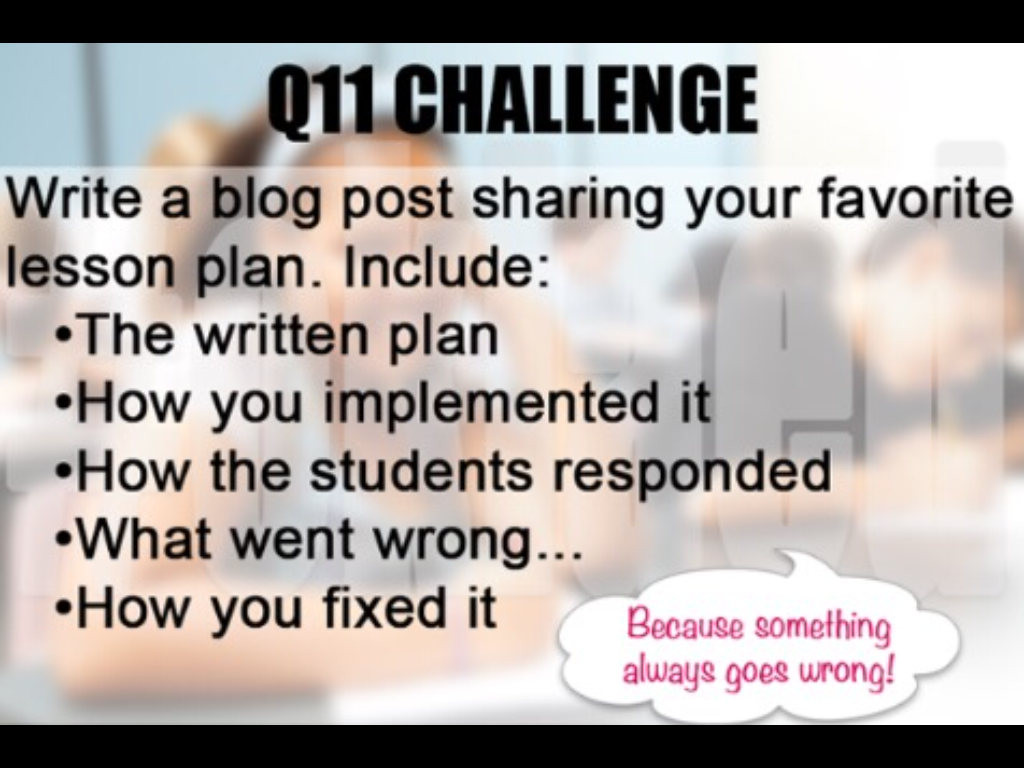
At the conclusion of this past Sunday's #oklaed twitter chat our moderator for the evening, Michelle Waters, challenged those in Oklahoma who write blogs which address educational themes to compose a post on the topic of our favorite lesson plan. Michelle is an English & Language Arts teacher within the greater Oklahoma City, OK area and an active #oklaed twitter participant. She has some wonderful posts over at her blog: Mrs. Waters' English.

My favorite lesson, or at least one that I really enjoyed using, from this past school year used a "Speed Dating" conversational format through which my AP United States students taught each other about an individual from the Progressive Era reform movements of the 1880s to 1920s. I have previously mentioned this lesson as part of another #oklaed bloggers challenge in my post titled #1CoolThing. This lesson can be easily adapted to other academic levels; the teacher can edit timing and/or expectations as appropriate for his/her students' needs. Also, while I have modified some of the expectations to meet the needs of my students, the premise behind this lesson did not originate in my brain. I participate in a private Facebook based professional learning community and learned about this strategy in this forum.

Speed Dating with Progressive Reformers

Learning Objectives:
  • College Board, AP United States History 2014-2015 Curriculum Framework
    • Key Concept 6.3.II.C: Challenging their prescribed “place,” women and African American activists articulated alternative visions of political, social, and economic equality.
    • Key Concept 7.1.II.A: In the late 1890s and the early years of the 20th century, journalists and Progressive reformers — largely urban and middle class, and often female — worked to reform existing social and political institutions at the local, state, and federal levels by creating new organizations aimed at addressing social problems associated with an industrial society
    • Key Concept 7.1.II.B: Progressives promoted federal legislation to regulate abuses of the economy and the environment, and many sought to expand democracy.
  • Oklahoma Academic Standards, United States History 1878 to the Present
    • Content Standard 1.3.C: Evaluate the contributions of muckrakers including Ida Tarbell and Upton Sinclair that changed government policies regarding child labor, working conditions, and the Sherman Antitrust Act.
    • Content Standard 1.3.D: Analyze major social reform movements including the Women’s Suffrage and Temperance Movement and their significant leaders including Susan B. Anthony, Alice Paul, and Jane Addams.
    • Content Standard 1.3.H: Cite specific textual and visual evidence to compare and contrast early civil rights leadership including the viewpoints of Booker T. Washington, W.E.B. DuBois, and Marcus Garvey in response to rising racial tensions, and the use of poll taxes and literacy tests to disenfranchise blacks and poor whites.
Procedures:
  • Ideally, students will have independently read the appropriate textbook passages relevant to the various reformers of the Progressive Era.
  • The teacher should cut the List of Reformers so that there a bunch of small strips of paper with only one reformer's name per strip. Then fold, wad, or ball these strips of paper and place them into a hat or bowl. Have each student draw out one strip of paper and this will be her/his assigned reformer. If the class size has more students than the quantity of reformers on the master list the teacher is free to 1) select additional reformers to be included (especially a reformer important to the state or local region of the students) or 2) double up on one or more of the reformers as the teacher deems appropriate. These assignments of reformers can be made immediately at the beginning of class on "Day One".
  • Day One: Give each student one copy of the Reformers Research Guide. Each student will complete this guide during one 55 minute class period; if additional time is need students may complete the remainder of the guide as homework that night. If students have access to computers, tablets, or smart phones provided by the school or through a BYOD policy then students could have access to the internet for researching the assigned reformer. If this is not the case then the teacher will need to explore resource options available in the classroom or school library or possibly assign this component totally as homework for students to research at home.
  • Day Two: Prior to students arriving, arrange classroom desks so that they are in clearly defined pairs. There are numerous ways to do this; I found that this Suggested Rotation Guide worked best for my needs within my classroom...the pairs of desks arrange in an almost complete circle. If I had created a complete circle then during the rotations, non of the students on the "inside" would ever interact with nor learn from the others on the "inside" (same would be true for those on the outside). This almost complete circle allows students on the outside to rotate in and those on the inside to rotate out. Either allow students to select their own seats within the set up or assign them (I put numbers on each desk and then students drew a number out of a hat as they arrived in class).
    • Hand each student a copy of the Chat Log Sheet on which they will take notes about the people they meet during each "speed date". Students may use their personal copies of the Reformers Research Guide to reference during each "date".
    • Briefly explain the idea of "speed dating" in which each pair will have a set amount of time to visit with each other (somewhere between 3 to 4 minutes). In this amount of time they are to share about their reformer and learn about their partner's reformer; they should record what they are learning about the reformers they "meet" on the Chat Log Sheet. At the end of the set time they will rotate to the next seat and repeat the process with their next "date".
    • Set your timer and go. DING! Students switch partners according to your rotation plan. Set timer again and go. DING! Repeat as often as possible but still leaving students approximately 5 to 6 minutes at the end of class to complete the final three reflection items at the bottom of the Chat Log Sheet.
    • Collect both the Reformers Research Guide and the Chat Log Sheet from each student to be used for your assessment purposes.

Student Responses: Overwhelmingly my students indicated the activity was "fun" and yet actually allowed them to get to know a wide range of reformers from the Progressive Era. Some "complained" that the limited amount of time made them feel rushed but realized that the rapid nature of the moment forced them to both listen better to their partners and to focus on the most important elements of their own assigned reformer. The formal assessment at the conclusion of the larger unit revealed that collectively the students ultimately learned more information about each of the reformers of this era than if I had simply attempted to lecture over them alone.

What Went Wrong:
  • The name of the activity "Speed Dating" initially gave some of my students a bit of concern. "Ewe, I don't want to date him!" I had not planned for the fact that I would have to clearly explain the conversational format was simply known as "speed dating" but that I had no agenda of anything romantic being in the works.
  • Another problematic moment came in one of my class periods in which I had a smaller number of students. The rotation process I was following ended up having pairs of students revisit each other prior to each student having visited all of the others. I had to adapt my rotation plan mid-stream to help guarantee that this did not occur. So my word of warning was...pay attention! Following a couple of minor reassignment of seats the rotation process continued without a hitch and repeat visits did not happen.
In the future, I can see this activity also working within other eras of history in which students need to explore a large number of personalities and yet the teaching time is short: the various leaders involved in establishing colonies in North America (each of Britain's "thirteen" but also French, Spanish, and Dutch), the era of 1830s-1840s reform movements often associated with the impact of the Second Great Awakening, and the Civil Rights Movement of the 1950s-1960s. I'm sure creative teachers within other disciplines can find a relevant use for this type of activity within their classes.