Sunday, August 16, 2015

Sharp Dressed Man

Forgive my tardiness in providing my response to one of the latest #oklaed blogger challenges. My friend "Blue" over at Blue Cereal Education presented the idea that every teacher needs his or her own "Entrance Video" [or song] in the spirit of professional wrestlers (click here for Blue's initial post on this topic and then click here for Blue's compilation of other blogger's videos).

My initial thought to Blue's request was "oy vey".  However, the more that I think about the idea, the more fun in now sounds. Just picture it: as the teacher steps into a classroom full of students eager for the the learning to begin a song starts, not just any song, but a song announcing that they audience is to be met with a figure of greatness...not just a mere mortal...but...wait for it...a teacher.

There are many articles, blog posts, and YouTube videos which have attempted to elevate the status of teachers within society to something beyond the images of a glorified babysitter or the mantra of "those who can, do. those who can't, teach." Most thinking people understand that both of these images of just plan horse sh!t, and those who want to help present a superstar status of teachers (which I appreciate so much!!) do their best to showcase teachers as such. A video from the comedy due Key & Peele made the rounds this summer and attempted to elevate the image of teachers to something comparable to that of highly sought after professional athletes.


So without much further ado, I want to present the "Entrance Video" that I would want played on my behalf as I step in front of my students:


Lyrics [with my edits]:

Clean shirt, new shoes
And I [know right] where I am goin' to
Silk suit, [bow] tie
[Teachin' kids] the reason why

They come runnin' just as fast as they can
'Cause every [kid respects the] sharp dressed man

Gold watch, diamond ring
I ain't missin' not a single thing
And cufflinks, [kind grin]
When I step I step out I'm gonna [teach you kid]

They come runnin' just as fast as they can
'Cause every [kid respects the] sharp dressed man

Top coat, top hat
Well I [can dream] 'cause [teacher's] wallet's flat
Black shades, white gloves
Lookin' sharp and [doin' what I] love

They come runnin' just as fast as they can
'Cause every [kid respects the] sharp dressed man

So next time you hear this song, just picture Mr. Bow-Tie Clad Burton stepping in front of a room full of AP United States History or AP Human Geography students ready to learn about their world.

Monday, July 13, 2015

Favorite Lesson

At the conclusion of this past Sunday's #oklaed twitter chat our moderator for the evening, Michelle Waters, challenged those in Oklahoma who write blogs which address educational themes to compose a post on the topic of our favorite lesson plan. Michelle is an English & Language Arts teacher within the greater Oklahoma City, OK area and an active #oklaed twitter participant. She has some wonderful posts over at her blog: Mrs. Waters' English.

My favorite lesson, or at least one that I really enjoyed using, from this past school year used a "Speed Dating" conversational format through which my AP United States students taught each other about an individual from the Progressive Era reform movements of the 1880s to 1920s. I have previously mentioned this lesson as part of another #oklaed bloggers challenge in my post titled #1CoolThing. This lesson can be easily adapted to other academic levels; the teacher can edit timing and/or expectations as appropriate for his/her students' needs. Also, while I have modified some of the expectations to meet the needs of my students, the premise behind this lesson did not originate in my brain. I participate in a private Facebook based professional learning community and learned about this strategy in this forum.

Speed Dating with Progressive Reformers

Learning Objectives:
  • College Board, AP United States History 2014-2015 Curriculum Framework
    • Key Concept 6.3.II.C: Challenging their prescribed “place,” women and African American activists articulated alternative visions of political, social, and economic equality.
    • Key Concept 7.1.II.A: In the late 1890s and the early years of the 20th century, journalists and Progressive reformers — largely urban and middle class, and often female — worked to reform existing social and political institutions at the local, state, and federal levels by creating new organizations aimed at addressing social problems associated with an industrial society
    • Key Concept 7.1.II.B: Progressives promoted federal legislation to regulate abuses of the economy and the environment, and many sought to expand democracy.
  • Oklahoma Academic Standards, United States History 1878 to the Present
    • Content Standard 1.3.C: Evaluate the contributions of muckrakers including Ida Tarbell and Upton Sinclair that changed government policies regarding child labor, working conditions, and the Sherman Antitrust Act.
    • Content Standard 1.3.D: Analyze major social reform movements including the Women’s Suffrage and Temperance Movement and their significant leaders including Susan B. Anthony, Alice Paul, and Jane Addams.
    • Content Standard 1.3.H: Cite specific textual and visual evidence to compare and contrast early civil rights leadership including the viewpoints of Booker T. Washington, W.E.B. DuBois, and Marcus Garvey in response to rising racial tensions, and the use of poll taxes and literacy tests to disenfranchise blacks and poor whites.
Procedures:
  • Ideally, students will have independently read the appropriate textbook passages relevant to the various reformers of the Progressive Era.
  • The teacher should cut the List of Reformers so that there a bunch of small strips of paper with only one reformer's name per strip. Then fold, wad, or ball these strips of paper and place them into a hat or bowl. Have each student draw out one strip of paper and this will be her/his assigned reformer. If the class size has more students than the quantity of reformers on the master list the teacher is free to 1) select additional reformers to be included (especially a reformer important to the state or local region of the students) or 2) double up on one or more of the reformers as the teacher deems appropriate. These assignments of reformers can be made immediately at the beginning of class on "Day One".
  • Day One: Give each student one copy of the Reformers Research Guide. Each student will complete this guide during one 55 minute class period; if additional time is need students may complete the remainder of the guide as homework that night. If students have access to computers, tablets, or smart phones provided by the school or through a BYOD policy then students could have access to the internet for researching the assigned reformer. If this is not the case then the teacher will need to explore resource options available in the classroom or school library or possibly assign this component totally as homework for students to research at home.
  • Day Two: Prior to students arriving, arrange classroom desks so that they are in clearly defined pairs. There are numerous ways to do this; I found that this Suggested Rotation Guide worked best for my needs within my classroom...the pairs of desks arrange in an almost complete circle. If I had created a complete circle then during the rotations, non of the students on the "inside" would ever interact with nor learn from the others on the "inside" (same would be true for those on the outside). This almost complete circle allows students on the outside to rotate in and those on the inside to rotate out. Either allow students to select their own seats within the set up or assign them (I put numbers on each desk and then students drew a number out of a hat as they arrived in class).
    • Hand each student a copy of the Chat Log Sheet on which they will take notes about the people they meet during each "speed date". Students may use their personal copies of the Reformers Research Guide to reference during each "date".
    • Briefly explain the idea of "speed dating" in which each pair will have a set amount of time to visit with each other (somewhere between 3 to 4 minutes). In this amount of time they are to share about their reformer and learn about their partner's reformer; they should record what they are learning about the reformers they "meet" on the Chat Log Sheet. At the end of the set time they will rotate to the next seat and repeat the process with their next "date".
    • Set your timer and go. DING! Students switch partners according to your rotation plan. Set timer again and go. DING! Repeat as often as possible but still leaving students approximately 5 to 6 minutes at the end of class to complete the final three reflection items at the bottom of the Chat Log Sheet.
    • Collect both the Reformers Research Guide and the Chat Log Sheet from each student to be used for your assessment purposes.

Student Responses: Overwhelmingly my students indicated the activity was "fun" and yet actually allowed them to get to know a wide range of reformers from the Progressive Era. Some "complained" that the limited amount of time made them feel rushed but realized that the rapid nature of the moment forced them to both listen better to their partners and to focus on the most important elements of their own assigned reformer. The formal assessment at the conclusion of the larger unit revealed that collectively the students ultimately learned more information about each of the reformers of this era than if I had simply attempted to lecture over them alone.

What Went Wrong:
  • The name of the activity "Speed Dating" initially gave some of my students a bit of concern. "Ewe, I don't want to date him!" I had not planned for the fact that I would have to clearly explain the conversational format was simply known as "speed dating" but that I had no agenda of anything romantic being in the works.
  • Another problematic moment came in one of my class periods in which I had a smaller number of students. The rotation process I was following ended up having pairs of students revisit each other prior to each student having visited all of the others. I had to adapt my rotation plan mid-stream to help guarantee that this did not occur. So my word of warning was...pay attention! Following a couple of minor reassignment of seats the rotation process continued without a hitch and repeat visits did not happen.
In the future, I can see this activity also working within other eras of history in which students need to explore a large number of personalities and yet the teaching time is short: the various leaders involved in establishing colonies in North America (each of Britain's "thirteen" but also French, Spanish, and Dutch), the era of 1830s-1840s reform movements often associated with the impact of the Second Great Awakening, and the Civil Rights Movement of the 1950s-1960s. I'm sure creative teachers within other disciplines can find a relevant use for this type of activity within their classes.

Tuesday, June 30, 2015

Cases by the Caseload

Over the past couple of weeks there have been some judicial rulings which have caused quite a stir. Most of the cases that are gaining lots of attention in my neck of the woods have been from the U.S. Supreme Court. However, as of today, there is a decision here in Oklahoma that has a some members of our legislature discussing impeachment proceedings for SEVEN of our nine States Supreme Courts justices. I've picked a sampling of these cases for me to share my insights regarding the decision which was rendered.

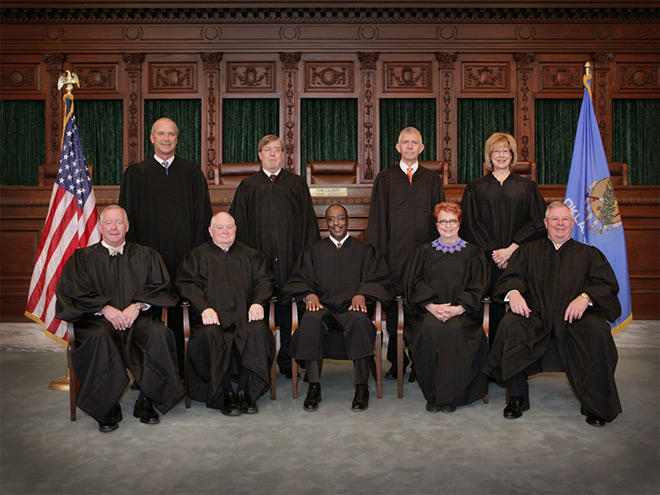
Oklahoma State Supreme Court
Nominated by Judicial Commission & appointed by the Governor
Tenure: 6 year terms renewable through retention by popular vote
Back: Vice Chief Justice Douglas Combs, James Edmondson, Steven Taylor, Noma Gurich
Front: Joseph Watt, Chief Justice John Reif, Tom Colbert, Yvonne Kauger, James Winchester
Prescott v. Oklahoma Capitol Preservation Commission: (read opinion here)
In the decision issued today, the State Supreme Court ruled (7 to 2) that the placement of a Ten Commandments monument paid for by private funds and placed on the grounds of the Oklahoma State Capitol violates Article 2, Section 5 of the Oklahoma State Constitution which prohibits the direct or indirect use of public property for the benefit of sectarian religious purposes. State Attorney General Scott Pruitt has publicly decried the decision and has requested a rehearing focusing on his assertion that the Ten Commandments are a significant foundation of Western legal traditions.

While I hold great value for the Christian scriptures in general and the Ten Commandments specifically, I believe that the court rendered the appropriate decision. Yes Judeo-Christian ideologies are important within Western history, concepts such as "don't murder" and "don't steal" are not exclusive to the Judeo-Christian tradition. Legal codes in ancient Greece and Roman which predate the influence of Jewish and Christian influence in Europe share these ideas so Pruitt's historical context loses merit. When a larger display of monuments representing various legal codes of Western tradition is placed on the Capitol grounds, then the historical context argument may have merit. But as of now, these justices have made the appropriate ruling and there is no reason to suggest impeaching them for simply doing their job.

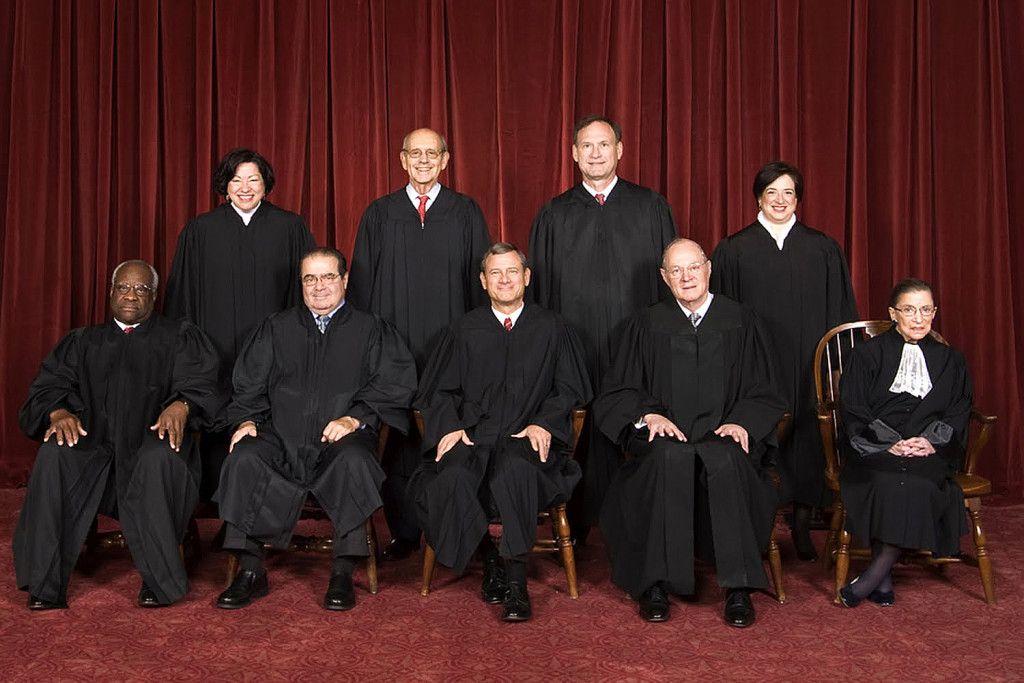
Supreme Court of the United States
Appointed by the President & confirmed by the Senate
Tenure: life-time
Back: Sonia Sotomayor, Stephen Breyer, Samuel Alito, Elena Kagan
Front: Clarence Thomas, Antonin Scalia, Chief Justice John Roberts, Anthony Kennedy, Ruth Bader Ginsburg
Arizona State Legislature v. Arizona Independent Redistricting Commission: (read opinion here)
By use of the initiative process (a procedure in various states through which the people themselves can propose and vote on laws external of the elected legislature), the people of Arizona, in an effort to limit partisan gerrymandering, removed from its state legislature the power to redraw the map of election districts based upon the decennial U.S. census and gave this power to a newly created state Redistricting Commission. The Arizona legislature sued claiming that this process denied them of a prescribed power found in Article 1, Section 2 of the U.S. Constitution: the power to conduct elections is given to the "legislature". The Supreme Court ruled (5 to 4) that the word "legislature" in this particular section of the Constitution referred to all legislative/lawmaking powers within a state, including the initiative process if allowed in a specific state, and thus the Redistricting Commission is constitutional.

I am not a fan of gerrymandering when it is accomplished for the purpose of giving one political party an unfair advantage over another; nor is this practice considered legal if it can be proven as the primary cause of redistricting efforts. Having said that, my initial reaction to this ruling was "what on earth?...'legislature' clearly means the elected representatives in a state!" So, while supportive of Arizona's efforts to limit gerrymandering I was aghast at the absurdity of the ruling...until I read it. That same Article/Section gives Congress the power to alter the criteria for election laws. Initiative and referendum (a procedure in which a legislature refers a proposed law to the people rather than to the governor) both became popular in the early 1900s. As states have added these procedures Congress began passing legislation to respect the changes these states made in their lawmaking practices. As of now, I support this decision.

King v. Burwell: (read opinion here)
The Affordable Care Act, commonly referred to as Obamacare, requested states to establish health care exchanges to help increase the quantity of people covered by a health insurance plan. ACA further authorized the federal government to create and oversee an exchange within a state which opted not to create its own exchange. Further, ACA offered tax credits to individuals/families whose income met certain requirements so as to help them afford the selected insurance plan. A lawsuit was filed contending that ACA only authorizes the tax credits in situations where a state established its own exchange and not within those states where the federal government created the exchange. The Supreme Court ruled (6 to 3) that the tax credits in state with the federally created exchange are legal. The heart of the ruling is premised on the idea that in many complex items of legislation the individual components are best understood within context of understanding the whole.

I do not like the Affordable Care Act. It is overly complex. It was rushed through Congress without thorough debate. Promises were made to both Senators and Representatives in order to get them vote for it which were then never fulfilled. I disagree with federal government requiring the purchase of a commodity simply based on living in this country (that is 100% different than the requirement to purchased car insurance because that is linked with a personal choice to drive a car). I disagree that the penalty for not having health insurance is now considered a tax; taxes should not be used as a penalizing method. Further, now that it has been declared a tax that makes the whole bill a revenue bill and since the revenue component did not originate in the House of Representatives and Article 1, Section 7 of the U.S. Constitution requires all revenue bills to originate in the House. There is simply a whole host of messy situations around the the entirety of the ACA. And yet, it is still currently law. Until such time as it is removed by legislative vote, overturned by the Supreme Court on some other legal argument yet to be raised, modified in some significant way, it is still the law. The ruling given in this case makes sense to me. While the wording of the tax credit passages did not specifically cite "federal exchanges", federal exchanges were authorized in other passages and understanding of the fullness of the ACA expresses an intent consistent in the offering of the tax credits for all exchanges period.

Obergefell v. Hodges: (read opinion here)
This decision (5 to 4) on the understanding of marriage is certainly making itself manifest through all forms of media attention. I'm sure my comments on a couple of the above cases have been enough to prompt angry villagers to threaten to burn down my home and/or run me out of town. Because this specific case is so complex, not only in the text of its ruling but also within the emotional stirrings that it makes within people on each side of the outcome, I will not provide my comments at this time in this forum...maybe another day.

All in all it's hard for me to clearly identify my personal approach to legal interpretation. There is an originalist/textualist/strict interpretation ideologue living within side of me. I want to base my legal insight on the words that were written within the mindset of the person that wrote them. Words have power; why did this person (or group of people) use this arrangement of these specific words? There was a purpose! At the same time, I truly recognize that there are a host of issues/ideas/technologies that have developed subsequent to the penning of those specific words that could never have been in the frame of reference of those who penned the words. I highly doubt that Ben Franklin and James Madison could have ever conceived of the idea that McDonalds and Holiday Inn could be construed as something so intrinsically linked with interstate commerce that they would envision the use of Civil Rights Act of 1964 as a means to help facilitate equity within interstate commerce/travel. Times change and even my strict interpretation gut knows I have to be loose/liberal enough to apply those original words into the most appropriate context for today. See...it really is a clash between the idealistic and the realistic sides within my core.


Sunday, June 28, 2015

#1CoolThing

Each Sunday evening at 8:00 PM Central Time a group of individuals who care about education within Oklahoma gather for a Twitter chat. There are faithful regulars, there are semi-regulars (like myself), there are infrequent visitors, there are pure lurkers, and other classifications I'm sure. All using the common hashtag of #oklaed within our postings, the volunteer moderator of the week posses a series of questions around his/her choice topic and then the various active participants respond. Most often there is lots of favoriting, retweeting, and side-bar conversations around the issues raised. As far as interactive and conversational professional development goes I find these sessions, more often than not, highly worthwhile.

The session that finished just a little while ago was led by Scott Haselwood, a math teacher in Edmond, OK. Through my time interacting with #oklaed I have learned that Scott is #Amazeballs in his incorporation of technology into his classroom instruction and is encouraging of other teachers as they seek to incorporate more technology into their classrooms or even just to stretch themselves by trying some new teaching strategy which they've never explored before. A theme which he uses as part of his encouraging spirit was the underlying theme of tonight's chat: #1CoolThing. To get an idea of these chats visit this archive on storify of tonight's chat.

Scott's final question of the night was more of a challenge. "Q8) Reflection makes us better - blog about your #1CoolThing lessons and share them with us! #oklaed."

So here is a sampling of #1CoolThing ideas through which I have had success engaging students.

Twitter Chats: Modeled on the idea of the #oklaed Twitter chats, I've incorporated Twitter chats into my AP United States History class. Throughout the course we use "Opposing Viewpoints" primary source documents as we explore a particular historical concept or idea. Students read the two perspectives overnight and then...in the past I would have them discuss the documents within a small group following a list of questions...I moderate the Twitter discussion during class-time using pre-selected questions and then as students answer I provide additional prompts to individual students or the full class as needed to insure that full understanding is obtained. Here is a sample Twitter chat on the debate between Alexander Hamilton and Thomas Jefferson on the question of having a national bank (archived on storify). One of the flaws which we've encountered is that not every student's posts show up in our hashtag feed. I know students' individual phone/tablet or Twitter account settings can impact this, but even when all else seems "right" there are still a couple which don't show up. Perhaps there is a Twitter expert our there who wants to share her/his thoughts with me??

Speed Dating: You have three minutes to get to know each other. DING! Now swap partners. Another three minutes. DING! Repeat... No my purpose is not to help my students find a prom date nor the love of their lives. But the idea of timed conversations between two individuals is a great way to have students teach each other. I used this conversational format as a way of teaching the various leaders of the Progressive Era Reform Movements to my AP United States History students. Each student was randomly assigned an individual reformer and then given time to research this person and his/her reform efforts/successes/failures so as to become an "expert" on this individual. Then during our "speed date" session each student is paired with another and in three minutes they rapidly teach each other about their reformers. DING! Switch partners. Repeat. This is a great way to cover a large number of important figures from a specific era in history within the short amount of time available for teaching in a survey history course.

Student Created Websites: Do you use a portfolio concept or have some other type of large project to be completed over time? Why not allow students to develop some 21st century skills along side the learning of the necessary content? Within my AP Human Geography course I have my students create a website which enables each of them to compare four countries (different regions, different cultures, different economic standings) as we progress throughout the units of our course. For each unit, students will add new information relevant to each of their countries and to study at hand (population demographics, cultural issues, political structures, agriculture & rural issues, economic development & industry, urban life, etc). While there are various platforms for creating free websites, I've come to enjoy weebly. Click here for examples created by my students. In the future I need to incorporate more of the blogging feature for students to better reflect upon their learning; I can also see students interacting with each other via the blogs to compare their personal findings with the findings of their peers.

Now It's Your Turn: If you're a teacher, what is #1CoolThing that you've used to successfully engage your students in learning? If you're not a teacher, think back to when you were in school...what was #1CoolThing one of your teachers did to help enhance your learning experience? Feel free to share in the comment section below or compose your own blog post and add the link in the comment section below.

Saturday, June 27, 2015

Why Teach?

a panoramic view of my classroom; spatial distortions courtesy of iOS

Recently Mindy Dennison presented a challenge to those in Oklahoma who write blogs which address educational themes to compose a post on the topic of “Why Teach?”. Mindy is a friend, a current music teacher in Choctaw, OK, a former colleague where I teach, and an active #oklaed twitter participant. She has some wonderful posts over at her blog: This Teacher Sings.

A little over a year ago I was involved in a lengthy project to explore lots of my thoughts regarding education and my place in the "teacher world". This project, a lengthy portfolio-application, resulted in my selection as the Moore Public School District's 2014 Teacher of the Year. Several of the entries help to explore Mrs. Dennison's requested topic, but I think the "Philosophy of Teaching" entry as a whole best encapsulates her desired intent. So, rather than creating a whole new writing for this post, I'll just provide a sample of something that I've previously written...

Thomas Jefferson articulated, “If a nation expects to be ignorant and free, in a state of civilization, it expects what never was and never will be" (source link). While the basic core of education is to ensure that information is passed along from one generation to another, I believe that teaching’s ultimate purpose is to equip students to be productive members of society so that they can engage with others for their mutual benefit. I use the ideals of global education to focus my classroom environment so as to meet this definitive purpose of education; when students explore questions, respect multiple perspectives, effectively communicate ideas, and act so as to have a positive impact (source link), they become the educated citizens idealized by Jefferson.

While there is legitimate value in knowing the rules of grammar, the scientific method, the steps of a geometric proof, or the sequence of events in history, these lessons without real-life application carry little meaning beyond the test. Regardless of whether curriculum objectives are created by the teacher or externally by district, state, or even federal educational leaders, exceptional teachers know how to use their instructional goals so as to engage their students in real-life inquiry and to further develop the critical thinking skills which their students will need throughout their lives. Outstanding educators enable students to use the elements of the lesson so as to gain a greater understanding of the bigger picture of life. My ultimate desire is to facilitate the dialogue occurring in my classroom with the expectation that my students will take greater ownership of their personal learning and explore answers to critical questions for their historic or geographical understanding. I then want them to seek the most productive manner in which to turn those answers into meaningful action plans to assist their fellow citizens on this planet. Further, distinguished teachers use innovative technologies to enhance their students’ 21st century skills. The very nature of human interaction, especially within the workforce, changes daily due to new technologies. I believe that our ever globalizing world requires me as teacher to incorporate as many hands-on technology opportunities into my lessons as I can; teaching is not about my comfort level but about the needs of my students.

Personally, my educational philosophies are incorporated into greater opportunities for my students to interact with myself, their peers, and their global community. I share a host of relevant resources and lead test review sessions through my Twitter account and my Facebook page. My students’ desks are arranged in groups so I can facilitate their collaboration in analyzing historic primary source documents or global current events articles and enhance their understanding. Additionally, blogging, website design, video creation, and a host of other online technologies enable my students to interact with the world.

The rewards for teaching come in many forms. Throughout my career I have received numerous letters, cards, e-mails, and verbal accolades from both students and parents showing their appreciation for the impact that my class and I have made on their lives and education; gifts and mementos have also been given, including an original painting which continues to hang in my classroom. In similar fashion, my colleagues and administrators have recognized my efforts through the various letters of recommendation they have attached to grants for which I’ve applied and by naming me as Southmoore’s 2013-2014 Teacher of the Year. The variety of grants I have received, especially for international study tours, and my annual invitation to the reading/scoring session for the AP US History exam are further testaments to my teaching accomplishments. However, no personal reward in my career is as meaningful as when one of my students takes what he or she has learned and uses it to impact their world.

Tuesday, June 23, 2015

Symbolically Speaking

"Symbols are the imaginative signposts of life."
--Margot Asquith, English author & prime minister's wife

Symbols invoke many things within out thoughts, minds, and emotions. They provide instructions: Ampelmann (German term for the little cross-walk figure) tells us when it is safe or not to use a pedestrian cross-walk. They keep us out of uncomfortable situations: figures similar to Ampelmann let us know which restroom facilities are the most appropriate for our personal use. They remind us of aspects of our identity: the band of gold worn on the 4th finger of the left hand many anything to you? Symbols are used to send a clear message.

Throughout western culture, especially within European expansion and subsequent American historical development, flags were used in various symbolic ways: to show ownership, to establish a land claim, to denote "we were here" (especially here first...U.S. flag on the moon). One of my favorite comedic commentaries on this idea of a flag's symbolic importance of establishing territorial ownership is a sketch by Eddie Izzard. Video Link (caution, some "language" is used)

Flags have been used to rally support of a cause. The Gadsden flag was used to encourage support of the "Patriots" within the American Revolutionary War--"Don't Tread On Me"--as a reminder of the violations of the rights guaranteed to all British subjects which had recently been carried out by the British government and military. It's interesting that some symbols/flags are appropriated by other groups...sometime with a similar cause. In that many supporters of contemporary "Tea Party" ideology believe that a large, powerful, centralized government is disrespecting the legal rights of the citizenry, many "Tea Party" rallies and events will make use of the Gadsden flag as a symbolic connection with that revolutionary spirit.

The United States Supreme Court has acknowledged the power of our country's flag as an important symbol. In a controversial decision which continuous to garner lots of debate, the Court has ruled hat as such a strong symbol of our country and then government which oversees the country, citizens of this country are protected in their right to use this symbol as they seek to communicate their ideas about this country. This includes a protection for the destruction of this symbol as part of a lawfully protected protest of government policies. Personally, it breaks my heart to see a symbol that so many have died to protect being desecrated...primary our service personal are risking their lives in service of the country, but when the flag, as a symbol of that country, is at risk they will fight to protect it as well.

Simply put, there is power in the use of flags for a symbolic purposes with our country's cultural and historic background.

"Southern Cross"
One flag/symbol that has garnered lots of attention in recent days in the wake of the tragic shooting of worshipers at Charleston's Emanuel African Methodist Episcopal Church. The Confederate battle flag, also known as the "Southern Cross", serves as a strong emotionally charged symbol to people of a variety of backgrounds. Many white southerners, including members of my own family, hold strong devotions to ideologies of "states' rights" and believe that there is a deep connection with this ideology and the reasons for why South Carolina and 10 other states seceded from the United States between late 1860 & mid 1861 and ultimately formed the Confederacy. As I read South Carolina's declaration of secession (and those of other states) I read of a state government who supported one sole "state right" (the owning of black slaves) and to prevent other states' from exercising a "state right" to prevent residence of their state from being placed into slavery (the federal fugitive slave laws limited non-slave states from exercising such a "right")---but that is a discussion debate for another time.

"Stars and Bars"
During the early Civil War battles it became evident that the flag which the Confederacy adopted as its official governmental flag, the flag known as the "Stars and Bars", carried toit was the misappropriation of this symbol that is the major catalyst to the continued hostilities.
close of a visual similarity to the flag of the Union, especially at a distance, and led to confusion among both sides of soldiers during battle. Thus, another flag was eventually adopted for use by the Confederacy during battle: the "Southern Cross". Again, my purpose here is not a discussion of the ideology of the Confederacy. What I've shared thus far is simply to provide a brief background into this symbol's origin. It this is where the story of the Confederate battle flag ended then continued controversy surrounding the war-era symbol would be nothing like what it is today. However,

It would be after the war, after the surrender of the Confederacy, after the coming of federal Reconstruction policies, and after growing dissatisfaction of some southerners with the social, economic, and political changes in the South that various vigilante groups, most prominently the Ku Klux Klan, emerged to harass, attack, and lynch southern blacks. The Klan appropriated the Confederate battle flag as a symbol of their efforts to help create a "new South". This "new South is quite simply the old South with its race-based caste system substituting slavery with a different form of subordination for blacks since slavery had been legally eradicated by the 13th Amendment. In combination with the white-hoods of the Klan, the Confederate battle flag become THE primary symbol of the terror inflicted upon any Southern black who gave even the slightest appearance of not being happy to reside at the lowest rung of this race-based caste system.

Over the next several decades the power and influence of the Klan ebbed and flowed and geographically spread itself west (with strength in 1920s-30s Oklahoma) and north (esp. Indiana and Ohio). As black soldiers returned from World War II and began efforts to obtain something similar to the racial equality, or near equality, which they saw in Britain and France they were met with resistance. As that resistance grew, especially in opposition to the Brown v. Board decision and subsequent efforts to fulfill its call for the integration of schools, in reaction to the restaurant and department store sit-in movements which began in Oklahoma City with Clara Luper and gained national attention in Greensboro, in response to the bus boycott in Montgomery, in retaliation to the Selma march, etc., etc., etc., this Confederate battle flag was THE symbol used by whites who sought to put blacks in "their place". State governments also made use of the flag part of official policy. South Carolina used the 1960s civil right movement as the rationale for its decision to fly the Confederate symbol atop its capitol's dome.

This flag was THE symbol of the continued effort to deny not only equality of political, social, and economic rights to black, but also to deny simple basic respect for human dignity. Regardless of what historic backdrop brought the creation and initial use of the flag, regardless of any authentic, perceived, or pretended political "states' rights" style ideology claims that surround the flag, it cannot be denied that THIS flag become THE symbol of both independent vigilante group efforts and state/local government efforts to retain white-supremacy even with the use of violent terrorism, torture, and murder. Your "heritage" argument has been sidelined by their "hate" agenda because they hijacked this symbol for their evil acts.

Display of this symbol can be appropriate within an authentic and accurate historical display, like a museum. However, this symbol, because of how it was misappropriated, has not place on the formal and ceremonial political/governmental property at any level within this country. If this upsets you then take out your discontent on those who hijacked this symbol for their terrorist purposes.


Thursday, June 18, 2015

Messiness of Money


The United States Treasury Department released information yesterday evening indicating plan to replace the image of Alexander Hamilton on the $10 bill as part of the previously determined plan to have the $10 bill edited by the year 2020. Hamilton's image would be replaced by the image of a female who has yet to be determined.

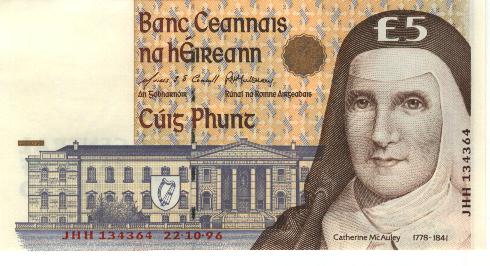
I have no problem with the incorporation of a female image into a prominent place within one of the commonly used pieces of paper currency within our country. A country's currency is one of the best ways to show and stress that which is valued within that society. I had the opportunity to visit Ireland in 1999 prior to the country switching over to the Euro. I was stricken by the fact that the people featured on the Irish Punt were not famed political leaders as is so common elsewhere (during the same trip I had visited the United Kingdom--every paper bill features the current monarch, Queen Elizabeth II).

Catherine McAuley, founder of the Sister of Mercy
James Joyce, novelist and poet
I was pleased with the online reports of a movement earlier this year to hold an unofficial competition to select the ideal female candidate to be selected for use on a piece of paper currency within the United States. Perhaps it was this movement which has inspired the Treasury Department's design to make such a change on the next piece of paper currency which has already slated for an edit. However, it seems to me that the Treasury Department failed to pay attention to the rationales behind the specific bill which was the "target" for the female image movement.

Andrew Jackson is a prime example of a historic figure to whom I refer as a "complex character" in American history. Yes, he is the hero of the Battle of New Orleans (War of 1812), he is the champion of the common man, and the era of his influence saw an expansion of democratic ideals and virtually universal suffrage for white men. And yet...much of his military fame following the Battle of New Orleans is connected with fighting the Seminoles in Florida. There is the ardent attacks of the Second Bank of the United States and the veto of its recharter which led to a major economic panic/depression shortly after he left office. And, of course, there is the entirety of the saga of Indian Removal...even though the worst of the "Trail of Tears" experiences occurred following the conclusion of his time as President they are still intricately linked with policies created by he and his administration. Andrew Jackson's policies regarding American Indians and the movement of the Southeastern tribes to lands west of the Mississippi River outweigh, by far, any of his redeeming qualities (much like Nixon...his foreign policies which brought greater peace with China and the Soviet Union are overshadowed by Watergate).

In my opinion, it is Jackson who should be replaced on the $20 bill rather than Alexander Hamilton on the $10 bill. Hamilton, in a similar spirit as with Jackson, is a self-made man born into lowly circumstances. He emerged as one of the heroes of the American Revolution (a close aide to General Washington) and of the founding era. While serving as the country's first Secretary of the Treasury under President Washington, Hamilton's financial programs helped set the fledgling country on a stable course; much of our modern fiscal policies are directly linked with the success of his early ideas--even though each Jefferson and Jackson were anti-National Bank we do still have a centralized "bank-like" institution which fits in best with the spirit of Hamilton. If we are going to have famed politicians on our MONEY, the man who is chiefly responsible for our national economic policies is certainly a figure to be honored.

So, in order to take a step toward greater gender equality in honoring those of our country's past, let's replace someone more commonly associated with the negative events of the our past rather than the one whose policies we still use on a daily basis.

Give Jackson the ax on the $20 but keep Hamilton.